Resealing Lava Lamp Caps and Globes
When to Reseal
Resealing is the final step of a fluid restoration. Carry it out after the globe has been flushed, the new fluid has been added, and the wax has been confirmed as functioning correctly at operating temperature. Do not reseal until all fluid-composition adjustments are complete — reopening a sealed globe damages both the cap seal and the globe neck, and repeated removals increase the risk of cracking.
If the globe arrived already leaking at the cap joint, complete the diagnosis steps first. A failing seal is often a symptom of thermal stress or a previous poor reseal rather than the root cause of the problem.
Removing the Existing Cap
The cap — the metal or plastic collar pressed or crimped onto the base of the globe — must be removed cleanly to avoid distorting the neck.
- Allow the globe to cool fully to room temperature. Never attempt cap removal while the globe is warm; thermal expansion holds the seal tighter and increases the chance of the neck chipping.
- Wrap the globe neck in a single layer of cloth to protect the glass. Grip firmly but do not squeeze.
- Examine the cap type. Screw caps turn counter-clockwise and can usually be freed by hand with steady pressure. Crimped caps require a different approach: insert a flat tool — a wide plastic pry tool works well — between the cap lip and the glass, and work around the circumference gradually. Do not lever at a single point.
- Once the cap lifts free, set it aside on a clean surface. Note its orientation; some caps are not symmetric.
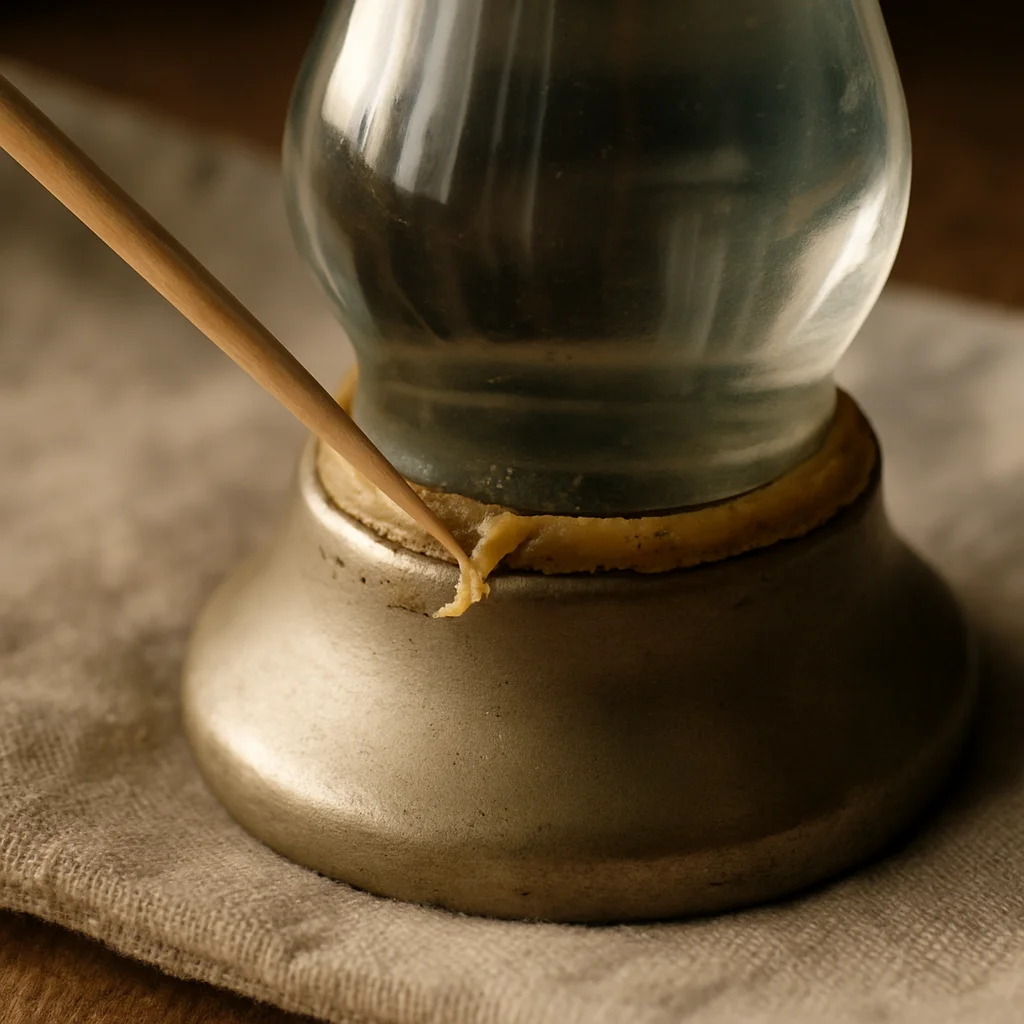
- Remove all old sealant from both the cap interior and the globe neck. Dried silicone sealant peels away in strips with finger pressure and a wooden toothpick. Petroleum-based compounds may require a brief soak in isopropyl alcohol (IPA — a high-purity rubbing alcohol, 90% or above). Wipe both surfaces dry.
Applying the New Seal
The correct sealant for most globe caps is a non-acidic (neutral-cure) silicone sealant. Acid-cure silicone releases acetic acid as it cures and can contaminate the fluid, causing cloudiness. Check the product label: neutral-cure types are labelled as such and typically cure without a strong vinegar smell.
- Apply a thin, even bead of neutral-cure silicone around the interior rim of the cap. Do not fill the cap — a bead approximately 2–3 mm wide is sufficient.
- Seat the cap onto the globe neck in one deliberate motion. Align it correctly before it contacts the glass; repositioning after contact disturbs the sealant bead.
- Press the cap down firmly and evenly. For screw caps, tighten to hand-tight only — overtightening distorts the cap and squeezes out too much sealant.
- Wipe away any sealant that squeezes out onto the globe exterior using a cotton swab dampened with IPA. Do this immediately, before the sealant begins to skin over.
- Stand the globe upright and leave it undisturbed for the full cure time stated on the sealant packaging. For most neutral-cure silicones this is 24 hours minimum; 48 hours is preferable.
Testing the Seal Before Reassembly
Once the sealant has cured, test before placing the globe back on the base.
- Hold the globe horizontal over a dry cloth and rotate it slowly. Any immediate seepage indicates the seal was not completed correctly. Allow the globe to drain, remove the cap, clean both surfaces thoroughly, and repeat the sealing process.
- If no seepage is present after one minute, stand the globe upright for a further 30 minutes and inspect the joint again.
- At this stage the globe is ready for reassembly onto the lamp base.
A properly executed reseal should last the lifetime of the restoration. For the complete sequence of steps leading up to this point, see the Lava Lamp Restoration Checklist or return to Restoring and Replacing Lava Lamp Fluid if the wax behaviour still requires adjustment before the globe is closed.