Frequently Asked Questions About Lava Lamp Restoration
The Most Common Questions, Answered
These questions come up repeatedly in restoration discussions and community forums. The answers below draw on documented techniques and fluid chemistry experiments — the same foundations used throughout this site.
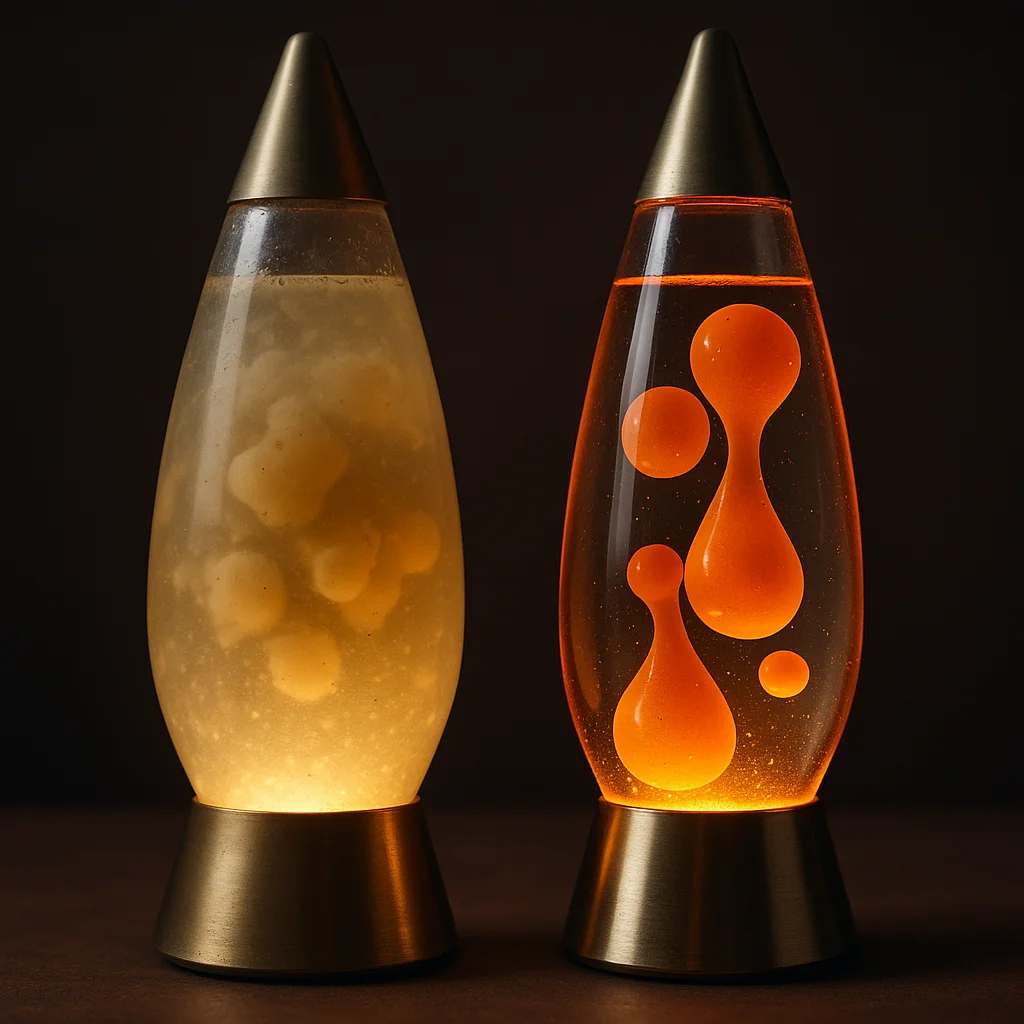
Why Is My Lava Lamp Fluid Cloudy?
Cloudiness is the single most reported problem in lava lamp restoration. It has several distinct causes, and identifying the correct one determines the correct fix.
Heat cycling degradation occurs when a lamp has been switched on and off repeatedly over many years. The surfactant blend — the mixture of water-soluble compounds that controls how wax and fluid interact — breaks down gradually. The result is a milky, permanently hazy fluid that does not clear on its own.
Wax contamination happens when small particles of wax detach and remain suspended in the fluid. This often follows rough handling or a hard impact. The fluid appears cloudy even when cold.
Evaporation and mineral buildup affects lamps that have had their caps disturbed or that have run for long periods at high temperature. Distilled water loss concentrates the remaining compounds and produces visible haziness.
Each cause requires a different approach. For a structured walkthrough, the Diagnosing Common Lava Lamp Problems guide covers each scenario with decision steps.
Is It Safe to Open a Lava Lamp Globe?
Yes, with correct preparation. The main risks are breakage and fluid spillage, not chemical hazard — standard lava lamp fluid is not acutely toxic, though it should not be ingested or left in contact with skin for extended periods.
Follow these steps before opening any globe:
- Allow the lamp to cool completely. This takes a minimum of two hours after the last use. Hot fluid and wax expand under pressure.
- Work on a stable, flat surface covered with an absorbent cloth or paper towels.
- Remove the cap using the method appropriate to the lamp’s construction. Mathmos-era caps are typically crimped; vintage American-made lamps often use a threaded or pressure-fit cap. Do not pry directly against the glass.
- Decant fluid slowly into a clean glass container. Do not use reactive metals or low-grade plastics for storage.
The full disassembly procedure, including cap types and tools, is covered in the Resealing Lava Lamp Caps and Globes guide.
Can the Wax Be Replaced If It Has Separated or Hardened?
Yes. Wax separation — where the wax breaks into multiple pieces that no longer merge — is a resolvable condition in most cases. Permanent hardening is less common but also addressable.
Separation is frequently caused by thermal shock: the lamp was cooled too quickly or placed in a cold environment while still warm. In many cases, running the lamp at the correct temperature for several hours will allow the wax to reflow and rejoin. If the wax remains fragmented after three to four heat cycles, replacement is the reliable solution.
Hardened or discoloured wax that does not respond to heat usually indicates oxidation or chemical change in the wax compound itself. At this stage, the original wax should be removed and replaced.
Replacement wax compounds, including community-tested formulations based on documented Mathmos-era specifications, are discussed in detail on the Replacing and Sourcing Lava Lamp Wax Compounds page.
How Long Does a Restored Lava Lamp Last?
A properly restored lamp — with fresh fluid, correctly balanced wax, and a sealed cap — can operate for several hundred hours before requiring further attention. The main variables are run time per session, operating temperature, and light source.
Sessions should not exceed eight to ten hours. Prolonged heat accelerates fluid degradation. LED bulbs run cooler than incandescent equivalents and may require wattage adjustment to maintain the correct operating temperature.
For ongoing maintenance guidance, the Lava Lamp Restoration Checklist provides a structured reference to revisit at each stage of the lamp’s life.