Lava Lamp Fluid Chemistry Reference
The Role of Fluid in a Lava Lamp
A lava lamp operates on one principle: two substances with nearly identical densities, one of which changes density when heated. The fluid — typically a water-based solution — fills the globe and acts as the medium through which the wax blobs rise and fall. The wax compound sits at the bottom when cold, denser than the fluid. As the bulb heats the base, the wax expands, its density drops below that of the fluid, and it rises. At the cooler top of the globe, it loses heat, contracts, and sinks again.
The margin between the two densities is extremely small — often less than 0.01 g/cm³ at operating temperature. This is why fluid chemistry matters. A formulation that is even slightly off will cause the wax to either sit permanently on the bottom or float permanently at the top. Neither is a malfunction of the wax; it is a density mismatch.
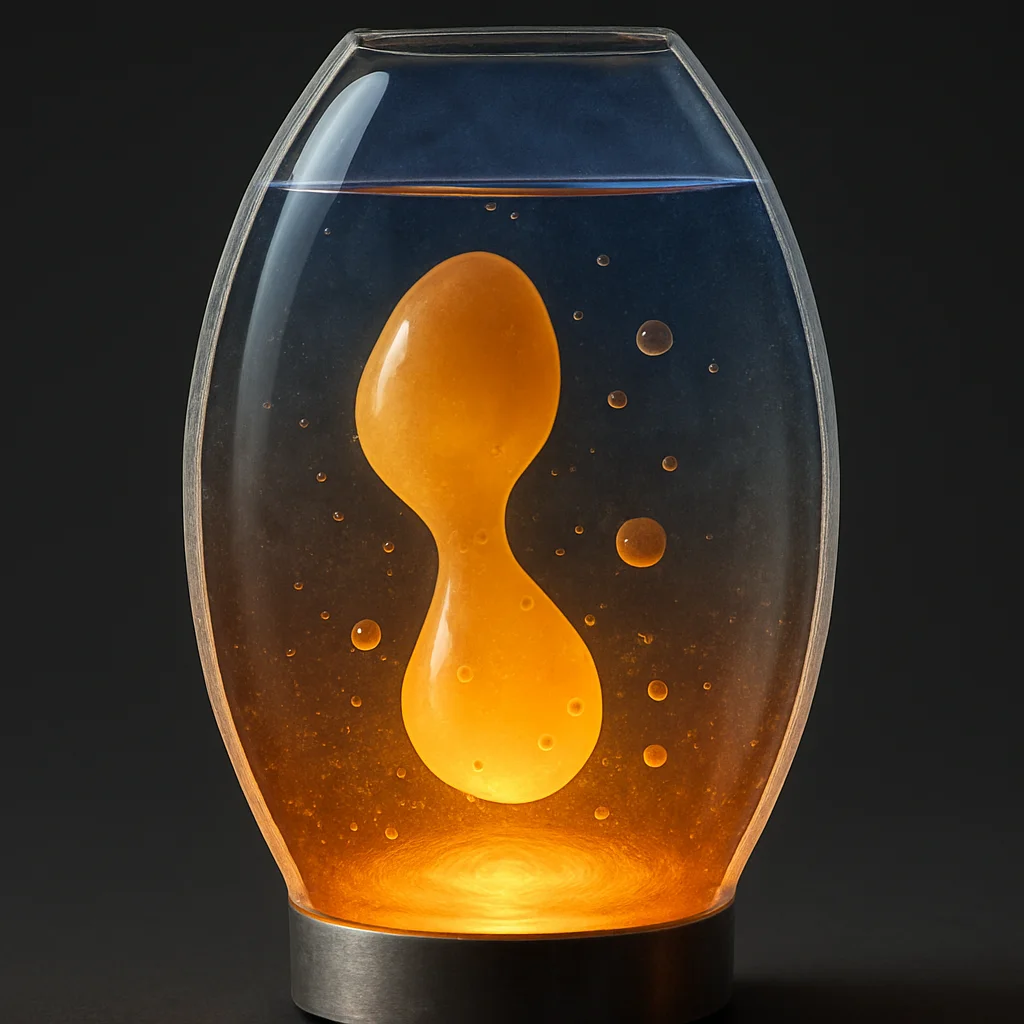
What the Fluid Actually Contains
Early Mathmos-era fluid formulations — documented through patent records and community disassembly experiments — used a mixture of distilled water and a small quantity of a surfactant (a surface-active agent that reduces surface tension between the water and wax phases). Common choices included polysorbate 20 and, in some formulations, a dilute concentration of sodium lauryl sulfate. The surfactant prevents the wax from coalescing permanently into a single immobile mass, which is the condition known as “lava clumping.”
A second component in many documented formulations is a density modifier — typically a water-soluble salt or a small proportion of propylene glycol. This adjusts the overall density of the fluid upward to match the wax at operating temperature. The exact concentration depends on the specific wax compound used, which is why fluid and wax are paired components, not interchangeable parts.
Key characteristics of a correctly formulated fluid:
- Clarity: The fluid should be clear or very lightly tinted. Cloudiness at rest, before heating, can indicate contamination, breakdown of the surfactant, or bacterial growth in the water phase.
- Density at 20°C: Typically in the range of 0.99–1.02 g/cm³, depending on the wax compound.
- pH: Slightly alkaline formulations (pH 7–8) tend to resist bacterial contamination better than neutral or acidic ones.
- Surfactant concentration: Too much causes persistent foam at the surface. Too little causes wax to clump or stick to the glass.
How Fluid Degrades Over Time
Fluid does not last indefinitely. Three degradation pathways are well-documented:
- Surfactant breakdown: Prolonged heat exposure causes surfactant molecules to denature. Once this occurs, the wax phase behaviour changes — typically becoming sluggish or producing persistent surface bubbles.
- Microbial contamination: Distilled water that has been exposed to air can support microbial growth over months or years. This produces turbidity (cloudiness) that does not clear with heating.
- Evaporation and concentration shift: If the cap seal fails, water evaporates preferentially, increasing the density of the remaining fluid. The wax then floats and will not sink.
If the fluid in your globe shows any of these symptoms, fluid replacement is the appropriate next step rather than further adjustment. The Restoring and Replacing Lava Lamp Fluid guide covers the full replacement procedure, including how to match fluid density to an existing wax compound using a simple hydrometer test.
Practical Notes on Reformulation
Restoring fluid from scratch requires distilled water — not tap water, which introduces minerals that shift density unpredictably. Surfactant is added in small increments; a starting concentration of 0.1–0.2% by volume is appropriate for most standard wax compounds. Density is adjusted afterward, not before, because the surfactant itself contributes marginally to the overall density of the solution.
For the wax side of the pairing, see the Replacing and Sourcing Lava Lamp Wax Compounds guide. For a broader overview of how this chemistry fits into a full restoration, the Lava Lamp Restoration Checklist provides a sequenced reference across all stages.